From entitlements to offers
by Andy Bovingdon | 10 Aug 2026
Modernize your subscription bundles without disrupting live customers
How the enhanced Bango DVM Migration Engine helps telcos consolidate live partner subscriptions, reduce in-life overhead, and unlock advanced multi-party bundles.
For many telcos, subscription bundling has moved from an innovation project to a core commercial strategy.
Entertainment, sports, gaming, productivity, security, health and lifestyle subscriptions are now used to increase plan value, drive acquisition, improve retention and differentiate in markets where connectivity alone is increasingly hard to defend.
But the more successful bundling becomes, the harder it is to manage.
Many telcos are now carrying a mixed estate: direct integrations with content providers, legacy entitlement records, partner-specific lifecycle rules, custom campaign logic, competitor platform dependencies and operational workarounds that were never designed for multi-party bundles. What started as a few simple partnerships can become a fragmented operating model for access, billing, support, reconciliation and renewals.
That complexity creates cost. It slows down launches. It increases in-life management overhead. It also makes every new creative bundle feel like another integration project rather than a simple marketing exercise.
The next phase of telco subscription bundling is not just about adding more partners. It is about moving from fragmented entitlement management to structured consumer offer management.
The problem: basic entitlements are not enough for advanced bundling
A basic entitlement confirms that a customer has access to a service. That is essential, but it only answers one question: should this customer be allowed in?
Advanced bundling needs a richer definition, basic entitlements are no longer good enough to support the latest industry-leading consumer offers. Telcos need to know the offer the customer is on, the plan that applies, the lifecycle phase they are in, the price now and at renewal, what happens at end of term, whether the subscription can be suspended, cancelled or upgraded, and how those rules interact with other services in a bundle.
When those rules sit outside the entitlement, the operating model becomes harder to scale. Offer context gets spread across CRM, billing, partner APIs, custom code, manual processes, spreadsheets or legacy platforms. The result is duplicated logic, inconsistent customer journeys, higher support risk, and slower time to market.
For telcos that want to compete with differentiated multi-party bundles, entitlement-only management becomes a constraint.
The solution: entitlements can now be seamlessly upgraded to full Consumer Offers
Bango previously published a technical overview of the DVM Migration Engine, explaining how existing subscriptions can be migrated into the DVM through a controlled process that includes schema validation, lifecycle mapping, sandbox testing, exception handling, controlled cutover and post-migration validation. That remains important background for technical teams.
The new capability goes further.
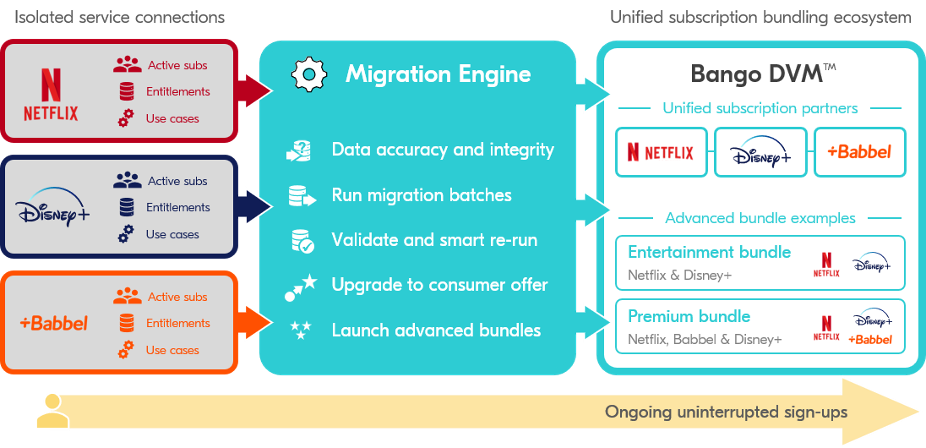
The DVM Migration Engine can now take customers with basic entitlements only – whether from DIY integrations, competitor platforms, or existing entitlement-based DVM implementations – and migrate them into a full Consumer Offers-based DVM setup.
This is the key shift: migration no longer just preserves access records. It can create the correct offer structure around those records.
Existing entitlements can be grouped, structured and managed as Consumer Offers, with defined offer characteristics such as lifecycle state, lifecycle timestamps, associated Offer ID, Offer Plan, pricing phases and renewal behavior.
In practical terms, the telco moves from “this customer has access” to “this customer is on this defined offer, in this lifecycle phase, with these commercial and operational rules.”
That is the foundation for scalable subscription bundling and a fundamental capability included in the Bango DVM Migration Engine. It ensures advanced subscription offers, including multi-party bundles, are quick and simple to launch, especially live offers with existing subscription partners.
Benefits: for business owners
For commercial, product and partnership teams, the value is straightforward: migration becomes a growth enabler, not just a technical cleanup.
Existing partner subscriptions do not need to remain trapped in old direct integrations while the business builds new bundles elsewhere. They can be moved into the same DVM offer framework used to launch, manage and optimize future subscription offers.
That creates a cleaner base for expansion. Telcos can consolidate today’s live offers, reduce the cost of maintaining partner-specific logic, improve visibility across the subscription estate, and launch more sophisticated bundles with less bespoke engineering effort. Operational costs to support separate legacy solutions can now be simply consolidated, allowing existing subscriptions to become part of a new, advanced bundling strategy.
This gives teams more room to differentiate. A telco that can combine multiple partners into a managed bundle, support phased pricing, handle renewals cleanly, and create future upgrade or downgrade paths has more commercial flexibility than one constrained by isolated, one-off integrations.
The practical benefit is speed with control: faster partner migration, simpler in-life management and a stronger platform for advanced bundles.
Benefits: for technical owners
For technical and operational teams, the value is structural consistency.
The DVM has evolved around a Consumer Offer > Offer Plan > Entitlement hierarchy. Which is important because advanced offer management capabilities depend on the entitlement existing in the right context.
Previously, migrated entitlements could be imported as standalone records. That preserved access, but it did not fully align those records to the Consumer Offers model that supports offer lifecycle management, along with all the advanced multi-party offer capabilities.
The enhanced migration flow solves this. It constructs a Consumer Offer based on the entitlement’s current lifecycle state, key lifecycle timestamps such as created, activated, suspended and terminated, and the associated Offer ID from the Products & Offers catalogue.
Once migrated, subscriptions can be managed through the DVM Consumer Offers lifecycle, including upcoming renewals, cancellations, end-of-term soft cancellation, and the path to future capabilities such as upgrades, downgrades, suspend, resume, pro-rated charging and partial refunds.
Proof in production: Proximus migrates subscription partners and launches advanced bundles
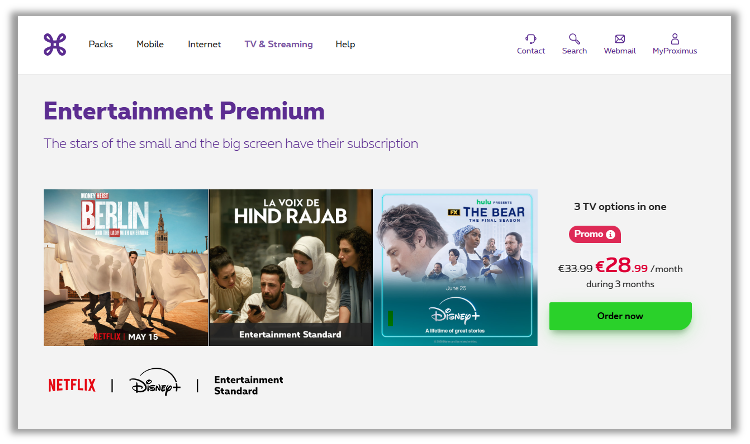
Proximus chose to migrate their existing direct partnerships into the DVM, enabling consumers to select or upgrade to new multi-party bundles.
The migration ran in parallel with the existing live offer and completed with zero issues and no interruption to consumer uptake.
Technical and logistical complexities, along with associated migration risks, are often what delays consolidation and the launch of innovative, market leading subscription offers. Live subscription customers cannot lose access. Partner reporting cannot break. Uptake cannot pause. Support teams cannot be left managing avoidable fallout.
A controlled migration approach changes the equation. Existing subscriptions can move into a more scalable operating model while customers continue to access and adopt the services they expect.
Migration is now part of the bundling strategy
The strategic opportunity is not simply to move old records into a new platform. It is to use migration as the bridge between today’s subscription estate and tomorrow’s bundling model.
For telcos with direct integrations, competitor platforms, legacy entitlement-based DVM integrations or hybrid estates, the route is clear:
- Migrate existing entitlements into the DVM
- Structure them as Consumer Offers
- Align them with the DVM offer lifecycle
- Consolidate in-life management
- Use that foundation to launch more advanced multi-party bundles
This allows telcos to simplify the present while preparing for a more differentiated future: fewer fragmented systems, less bespoke lifecycle logic, faster partner onboarding, improved operational visibility and a stronger commercial base for subscription bundling.
The bottom line
Telcos do not need to choose between protecting existing live customers and modernizing their bundling strategy.
With the enhanced DVM migration capability, basic entitlements can now be upgraded into fully specified Consumer Offers. That gives telcos a practical route to consolidate existing subscription partners, reduce operational complexity, and unlock the advanced offer management capabilities needed for the next generation of subscription bundling.
For business owners, that means faster innovation with less operational drag.
For technical owners, it means cleaner lifecycle management and a more scalable integration model.
For customers, it means continuity: the subscriptions they already use keep working while the telco builds a better bundling experience behind the scenes.
Next steps?
Ready to consolidate your subscription estate and launch more advanced bundles?
Speak to Bango about migrating existing subscription partners and live offers into the DVM Consumer Offers framework.
Related reading
For technical details on the core DVM Migration Engine – including schema validation, sandbox testing, lifecycle mapping, exception handling, controlled cutover and post-migration validation – read the technical overview of the DVM Migration Engine here.